


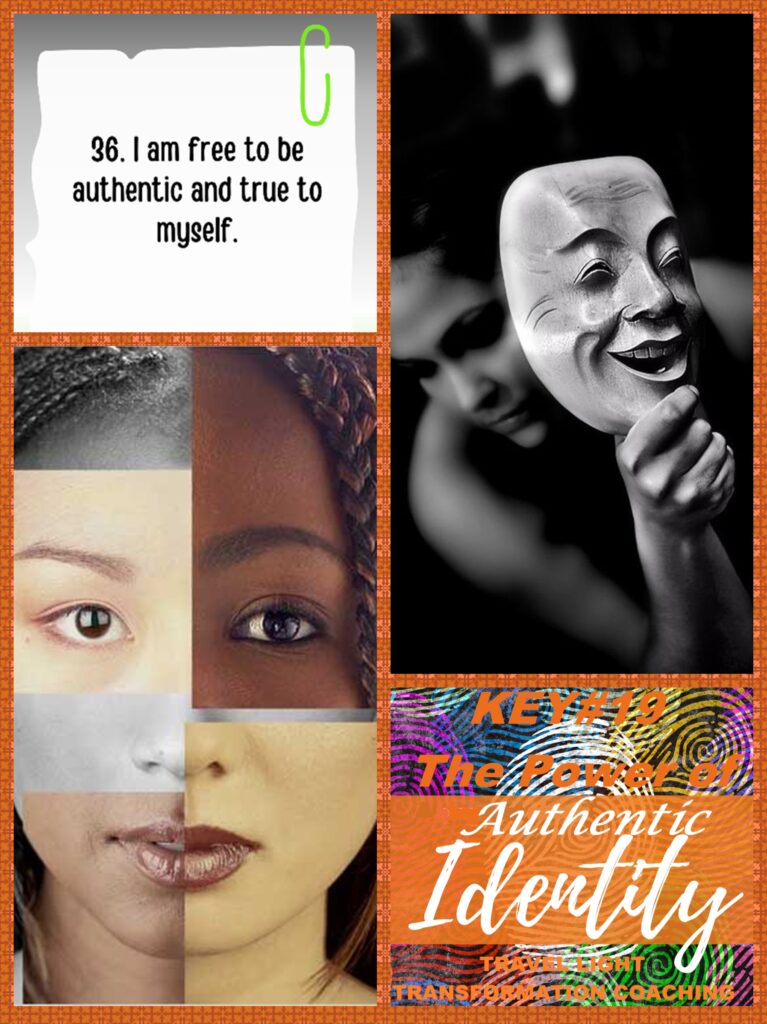
Since becoming a Transformation Life Coach I discovered the importance of this key on a whole new level. I always thought that I was building my identity on a solid surface and showing the world the real me, but as my understanding about the key grew, I became aware of subtle conflicts that proved otherwise. I recently discovered the importance of this 19th key in personal empowerment, or becoming the best version of yourself, and I’m still working on stepping into my authentic identity on a regular bases in order to live a life in abundance.
I invite you to take this step with me, and to learn this critical skill by following the tips I share with you in this article: the world needs our authenticity! Ask yourself: “Am I being authentic in my identity or am I living a lie? (Yes, that’s the alternative – ouch!) If yes to the latter or you’re unsure, please keep on reading my non-academic article. You will soon recognize the symptoms that result from trying to deny or alter your authentic identity.
Your authentic identity goes beyond your occupation, your possessions and even the role you play (so & so’s wife, -mother, -daughter, -sister, -friend). All of those could be lost in an instant. So if you build your identity on them, you must realize that it can be temporary and that you might have to rebuild it sometime in the future. Why take that risk?
Let’s start by breaking down this key into two individual concepts: authentic and identity.
Being authentic explained in psychology is when your internal representation is congruent to your external representation. In other words: what you show people around you about yourself is how you truly are as a person on the inside. Your thoughts, words and actions all align with each other.
THOUGHTS ↔ WORDS ↔ ACTIONS = AUTHENTIC
When these three elements don’t align, psychologists say you are incongruent. I want to go as far as saying: “Trying to be like somebody else is (1) lying to others, but most importantly (2) lying to yourself.”
(1) When you live a lie, you are subconsciously always on the edge, because thoughts like “what if I get caught? When will others discover that I’m not as smart / fun / experienced as I pretend to be?” keeps running in your subconscious mind. Authentic people don’t have those fears.
(2) Lying to yourself by pretending to be different than your authentic self leads to negative beliefs. Remember, on a subconscious level you know exactly what your authentic identity looks like. When you try to be different, you subconsciously tell yourself lies like: “I’m not good enough the way I am”. Authentic people don’t fall for those beliefs, because they are true to themselves.
Both these states of being can cause a long list of negative symptoms with disastrous effects like low self-esteem and low self-worth, insecurities, indecisiveness, a lack of intimacy in relationships, negative emotions like loneliness, guilt and shame and symptoms of depression and anxiety.
Elements of Identity
Your identity consists of five elements:
- Personality traits
- Abilities
- Likes and dislikes
- What motivates you
- Belief system
These five elements will not be the same for any two people. There might be close similarities, but every single person in the universe has a unique combination. And the world wants you, no – needs you, with your unique combination of elements.
I want to park at the last element, your belief system, for a while because I think it’s a crucial, yet misunderstood concept when it comes to this 19th key of personal empowerment, or becoming the best version of yourself.
What is meant by Your Belief System?
Please note: Not to be confused with your religious beliefs or your faith.
Beliefs are ideas or concepts that you have accepted as the truth at some stage in your life – either consciously or subconsciously. These beliefs are usually passed down from your parents, peers, society or religion. I like to compare your belief system to a filter in your subconscious mind. Everything you experience or perceive passes through this filter in a split second. The result then causes an emotion, a reaction, an opinion or a decision based on specific beliefs you have which you may or may not even be aware of.
Let me give you a general example:
The belief (subconsciously): “The unknown is unsafe and dangerous. Rather remain in your comfort zone where it is safe.”
The origin: A toddler wants to try something new like climbing stairs or on top of the coffee table, and the parents prevent the child from doing that with warnings like: “Don’t do that! You’ll get hurt!” Obviously with good intention to keep the child safe. Person A will keep the belief positive: “The unknown is exciting, I’m going to try that again when nobody is watching.” But Person B will start accepting the belief that “the unknown is dangerous and worth being terrified of because I will get hurt.”
The result: This belief sure has its purpose for the child while being a toddler, but as the child grows up, that belief no longer serves him / her. The result in an adult is that this belief can prevent Person B from exploring alternative options, taking risks like starting their own business and making changes for the better. Every unknown situation in person B’s life will pass through this filter and be perceived as a dangerous threat.
The danger of an inauthentic identity
The same happens with the beliefs that develop about our authentic identity when we lie to ourselves in pretending to be somebody else. Can you imagine the damage that can be done if you have subconsciously accepted beliefs like: “I’m not good enough the way I am, I must be more / better.” “I’m not worthy of love / kindness”. “I’m a loser; nothing ever works out for me.” “The world doesn’t need me; nobody will even miss me when I’m gone.” Those kinds of beliefs are evil LIES and need to be destroyed so that you can step into your authentic identity and live a life in abundance.
The world needs exactly what you have to offer, and nobody else can replace you. Not another “awesome person” you try to copy, not the transformed perfect version of you, but the authentic you with your strengths and weaknesses. Follow Oscar Wilde’s wise advice: “Be yourself. Everyone else is already taken!” Let’s look at some common obstacles you might encounter:
What keeps us from stepping into our authentic identity?
- Lack of self-esteem
- Fear of judgment
- Fear of rejection
- Strong desire for others to like us – people pleasing
- Comparing ourselves or our circumstances to others
- A negative belief system
For most of my life I was blissfully unaware that some of these obstacles stood in my way. The freedom that came from releasing the fears and changing some of the limiting beliefs that prevented me from stepping into my authentic identity after completing the 20-hour Transformation Coaching System™ myself was so liberating! I witness the effects of Negative Belief Therapy™ in my clients when limiting beliefs are replaced by truths, and it amazes me every time. Take a look at the additional benefits.
The benefits of stepping into your authentic identity:
- increase self-image
- Enhance work performance and productivity
- Strengthen personal connections
- Release creativity
- Improves symptoms of depression and anxiety
- Lowers stress levels
- Give others the freedom to step into their authentic identity
- Helps you trust your choices because they align with your values and beliefs
- Gives you a sense of belonging and purpose
- You don’t get upset when somebody doesn’t like you
- You stop comparing yourself to others
- Increase resilience to bounce back after hardships
10 Tips on how to be your authentic self:
- Get to know your authentic identity. Most of us are aware of our strengths by now, and it’s not difficult to accept them. It’s usually the weaknesses that we struggle to accept. Somehow personal empowerment creates the false perception that we must first change those weaknesses before we can be empowered. Such nonsense! You will wait forever before you walk in your authentic identity, because you will never be perfect! Nobody will be. Learn to love your weaknesses. Stop hiding them! And don’t resist them because whatever you resist will persist. Be kind and gentle with yourself and accept the fact that those weaknesses are as much a part of you as your strengths. However, we are constantly in the process of managing our weaknesses.
- Identify your limiting beliefs. This is much easier said than done. You really need to be creative here with an open mind. What is holding you back? What belief is behind it? Is it the truth? Is it still serving you? Is it in line with your values or moral code? If not, you seriously need to consider replacing that belief with a new, powerful one. I have a technique to help you with the change if you are unsure how to go about it.
- Check the stories you tell yourself about yourself. Negative self-talk is destructive to authenticity. Thoughts such as: “I’m not good enough and will never be”, “I’m useless”, “I’m too thin / fat / stupid / ugly”, “I wish I was more like him / her”, “I will never change because this is just the way I am” makes it impossible for you to live out your authentic identity. Consciously shift your focus to your strengths and change the story you tell yourself about yourself.
- Practise mindfulness. Be present in the NOW, and stop living in the past. We’ve all made our fair shares of mistakes. Take the lessons you learned from your past mistakes and let go of the negative emotions of guilt, shame and fear. If you are unsure how to be mindful, read the tips in my article.
- Stretch your comfort zone. Years of pretending to be what or who others expect you to be will be your current comfort zone, whether it’s destructive to you or not. Accepting your authentic identity starts at the end of your comfort zone. It might feel strange at first; read these tips in my article if you get stuck and need assistance.
- Create your purpose. You have to realize that you were born with a cocktail of special gifts and talents nobody else has. And your particular cocktail is much needed in the family / community / workplace where you currently find yourself. You have a purpose, and when you create it daily, you will soon realize the significance of being your authentic self. Here are some tips on creating your purpose
- Surround yourself with people you have authentic connections Even if it’s a handful of people where you feel safe to be your authentic self, seek them out. They will lift you up and love the real you. Set healthy boundaries in these relationships from the start.
- Cultivate positive emotions. Like gratitude, forgiveness, generosity and awe. These are all keys to personal empowerment with their own benefits, but they also unlock your authentic identity. It’s hard work, but oh! so effective and worth it!
- Stop caring what others think of you. I know, I know: easier said than done! It’s normal to want to be accepted. But if you need to change yourself in order to fit into a certain group, note the red flags! Accept the fact that not everybody will like you whether you are authentic or not, and that it’s okay. Remember that what people think of you is normally a reflection on them, not you.
- Be brave to be vulnerable. Admitting your weaknesses, fears and feelings to people close to you can be terrifying, but also very liberating. Be honest and see what a positive effect it has on real connections that are worth it.
For the believers:
It’s important (and also a HUGE privilege) for believers to base our identity on who we are IN JESUS. What does your identity in Jesus looks like?
- You are a child of God, His heir (Rom 8-14-17)
- You are more than a conqueror (Rom 8:37)
- You are capable of anything (Phil 4:13)
- You were created for a relationship with God (Jer 24:7)
- You were fearfully and wonderfully made (Ps 139:14)
- You are righteous, spotless before God because Jesus is your Mediator (1 Cor 1:30; Col 1:22)
- You have a gentle spirit [gracious, unselfish, merciful, tolerant and patient] (Phil 4:5 AMP)
That is the way God sees you, and that is eternal. As long as you have faith in Jesus, nothing can change that; ever! No circumstance, no action, no sin, no person, no emotion, no loss, no divorce, no dismissal, nothing, nada.
Comparing yourself to another whether it’s your looks, your possessions, your circumstances or even your relationship with God is not only a waste of time, it also keeps you stuck in a state of dissatisfaction while you miss the life in abundance that was promised.
Know, believe and accept the fact that God made you in a very unique and specific way with all your strengths and weaknesses (oh yes!) so that He can use you at a time and in a place that He has planned since the beginning of time. You are no accident; you are not where you are by accident and you don’t deal with certain people by accident. Or by chance. God wants to use you just as you are (and not only once you are transformed) for His glory and His kingdom. What an unfathomable truth!
Place your authentic identity in Jesus, whether you feel far from God or closer to God. How you feel (your emotions) are not always true, but every word of God proves true; He is a shield to those who take refuge in Him (Prov 30:5).
Embracing Your Authentic Identity
If you’re struggling to get rid of certain limiting beliefs about your identity that no longer serve you, one of the techniques I use in the 20-hour virtual online Transformation Coaching System™, Negative Belief Therapy, is just what you need. As soon as you drop your mental and emotional baggage, you will Travel Lightly through life with new, true beliefs about your unique, authentic identity. Send me an email TODAY to set up your free 30 minute coaching session.
Contact me TODAY for a free 30 min online Session!
I am a certified Transformation Life Coach operating in Riebeek Kasteel, Western Cape of South Africa. I also do virtual online life coaching sessions, so no matter where you are situated, all you need is an internet connection, a mobile phone or computer, and a space where you can meet with me uninterruptedly once a week for two hours.
Follow me on Instagram or like my Facebook page.
The next AND FINAL key #20 to personal empowerment (becoming the best version of yourself) is FOR BELIEVERS ONLY – the POWER OF FAITH. Make sure you don’t miss it by receiving an email when the article is published. Just complete the form below.

REFERENCES:
- https://www.tonyrobbins.com/personal-growth/how-to-be-yourself/
- https://www.weforum.org/agenda/2016/08/10-habits-of-utterly-authentic-people/?DAG=3&gclid=Cj0KCQjwwvilBhCFARIsADvYi7JdNpDTm4ATdrcmlTeCM2CCLnnh8jmlDMvWfXFMpkh2IQHnpMXLA3gaAj35EALw_wcB;
- https://www.healthline.com/health/sense-of-self
