


Welcome to the 12th key of personal empowerment, or becoming the best version of yourself and living a life in abundance: The Power of Forgiveness. I have learned and grown so much while writing every non-academic article in this series and this one is no exception.
I have realized while doing my research, that I was unintentionally stuck in the bad habit of taking offence, and holding on to, even nurturing, that offence. What an eye opener! But what an immense relief once I’ve realized I can change that bad habit and replace it with the successful habit of unconditional forgiveness. Not that I’ve perfected that habit in any way, but step one is awareness and I’m working on step two on a daily basis.
Unconditional forgiveness is when a victim replaces ill will or thoughts towards an offender with good will and blessings (ouch!) – with or without an excuse or even an acknowledgement of the wrong that was done (double ouch!!)
What forgiveness is NOT:
- An eraser – meaning: all your memories, thoughts and emotions that were triggered by the offence don’t miraculously get wiped out – unfortunately!
- Justifying the wrong that was done to you.
- Giving your permission to the offender to continue with the wrongdoing.
- Making excuses for the offender.
- A sign of weakness.
- Conflict avoidance.
- Reconciliation.
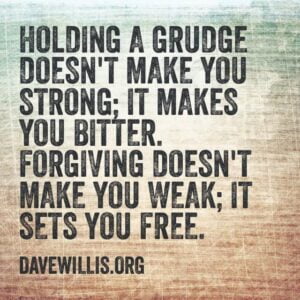
It’s important to distinguish between two types of forgiveness: Decisional and Emotional. The former refers to choosing to let go of the grudge and to treat the offender with respect and as a person of value. The choice to exchange curses with blessings. The sooner you make this choice, the better. The longer you put it off, the more the grudge festers and the more intense long-term negative effects you will experience.
Emotional forgiveness is where most of us get stuck, because it’s not instantaneous like decisional forgiveness. Because we still feel the emotions of anger, hurt, resentment, hostility, bitterness and even hate, we mistakenly assume that our decisional attempt to forgive was unsuccessful. Then, in order to force forgiveness (whether your reasons are religious or to support your moral values) some victims try to suppress these emotions (guilt now joined the cocktail of negative emotions). When they fail, they give up and surrender to resentment, retaliation and anger.
The bigger the offence, the longer it takes to reach emotional forgiveness. In extreme cases, it can even seem to be impossible to ever reach that level of forgiveness. In such a case, decisional forgiveness must be actively pursued on a daily, hourly or even minute-by-minute basis. Realizing the negative effects that resentment has on your physical and mental health should serve as motivation.
The health effects of holding on to a grudge vs forgiveness:
| Physically: increase production of cortisol | Calms stress levels |
| Therefor: increase in heart rate & blood pressure | Lowering risks of heart disease & blood pressure |
| Anger can cause chronic headaches | Reduces pain |
| Slowing or stopping of digestion | |
| Can cause emotional eating & weight gain | |
| Weakens the immune system | |
| Can cause insomnia | Improves sleep |
| Improves cholesterol | |
| Mentally: Increase depression & anxiety | A natural remedy for depression and anxiety |
| Can cause substance dependence & -abuse | Reduces substance abuse |
| Higher life satisfaction & positive emotions | |
| Higher self-esteem |
You see, forgiveness has much more to do with the victim, than the offender. When you hold on to a grudge, you form some sort of emotional bond with the offender, linking yourself to him / her. The offender starts occupying your thoughts and eventually influencing your decisions and affecting your mental health. While you as the victim experience all these negative effects, the offender blissfully continues with his / her life, often not even aware of the offence that was taken.
The moment you forgive, you break that link and set yourself free from the offender and all the negative effects of holding on to a grudge.
Practice forgiveness with the REACH model by Everett Worthington:
The best advice I can give when it comes to the power of forgiveness is: start small and forgive quickly. Practice forgiveness in the grocery store when someone cuts the queue in front of you. Or accidentally step on your toe. Or when the waiter doesn’t get your complex order 100% correct the first time. Or you have to wait 5 minutes too long before being served. Increase your forgiveness fitness level with the small stuff; so that when the bigger stuff hits you, you are in the habit of rapid, unconditional forgiveness.
I want to share a forgiveness model by Everett Worthington. His mother was murdered in her home on New Year’s Eve of 1996. He managed to forgive the murderer in about a month. No wonder he is referred to as ‘a leading expert on forgiveness’! REACH stands for Recall, Emphasize, Altruistic gift, Commit and Hold. Let’s take a look at each step:
Recall – Practice mindfulness and become aware of the offensive behavior, the offender, the situation and all the emotions attached to the incident. Don’t suppress any emotions, but allow them to be present. Close your eyes, and visualize the incident if you struggle to get in touch with the emotions. Don’t focus on the offender’s negative characteristics too much, and don’t drown in self-pity, but try to stay as objective as possible. Recall the negative effects resentment has on your physical and mental health.
Empathize – “Hurt people hurt people”. Never make excuses for the wrong, hurtful action, but try to understand where the offender comes from. The better you know the person, the easier this might be. For example: if you know that your spouse is under severe pressure at work, you might be more understanding when he / she lashes out uncalled for. Once again, do not downplay the action, but separate the action from the person.
Altruistic gift – Forgiveness is a free gift that you can give others. Remind yourself of times when you received this gift, and how unconditional forgiveness made you feel.
Commit – Choose to forgive (decisional forgiveness). Say it out loud, write about it in your journal or discuss it with a friend you trust if you can’t discuss it with the offender.
Hold – Finally, hold on to your forgiveness for dear life. When the memories and negative thoughts and emotions come, remind yourself that you have forgiven and that you only want good for the offender. Say the words “I choose to forgive you!” out loud or read your journal entry.
Finally, let go of any expectation. Don’t expect an apology or a thank you. Don’t expect the offender to change, but give him / her space to change. Don’t expect reconciliation or that the relationship will immediately be restored to its prior level.
Reconciliation or restoration is not a pre-requisite or a consequence of forgiveness so let go of that expectation or belief.
The Power of Forgiveness for the believer:
“Seventy times seven” does not refer to a mathematical problem. It’s not as if we can say: “I’ve forgiven once today, so only four hundred eighty nine times left, and counting.” No. The number seven in the Bible refers to the perfect, infinite number. So Jesus was telling Peter in Math 18 that the number of times we should forgive is so great that we should not be counting. Infinite times; zero exceptions. That is the assignment, and I believe with my whole heart that Jesus would never give us an order that is impossible to accomplish, or one that He is not willing or able to give us everything we need in order to succeed.
I know that some wrongdoings are just so painful, evil and inexcusable that this assignment might seems totally impossible or not deserving of forgiveness – “humanly impossible to forgive” you might say.
In these cases, unconditional forgiveness is only possible if we can manage to separate the sin from the sinner. Not forgiving the action, or the horrible wrongdoing, but seeing the offender for being more than just his / her actions. You can bless the offender without excusing or forgetting the hurtful, wrong action.
To be honest: even though it sounds easy enough, that has always been something that I find particularly hard to do on my own, but I’m trusting the Holy Spirit to develop, perfect and complete the good work in me that He has started (Phil 1:6).
I’ve realized that I help myself when I choose to forgive. I’m happier and physically and mentally healthier if I choose to uproot the poisonous weeds of offence in my life. I also help the offender by letting him / her go so that God can start doing the good work in his / her heart without me being in the way.
While I’m holding on to offence, I’m playing the judge, and we all know that role belongs to God alone. He sees you and He neither slumbers nor sleeps. He will judge the offensive action. Maybe not in this life, but surely in the one hereafter, for all eternity! Trust Him!

Embracing Unconditional Forgiveness
Unconditional forgiveness is crucial in the life of a believer. Jesus taught us in the Lord’s prayer to ask our Father to “forgive us our debts, as we have forgiven our debtors (letting go of both the wrong and the resentment)”. If you currently feel far from God, take a hard look at what grudges you are holding. Grudges form a wedge between you and God.
Not because He’s not pleased with you or punishing you, but because of your own guilt and shame. You see, His Holy Spirit inside you gently nudges you to forgive and to be obedient to His command.
Because your Creator knows what’s best for you! If you keep resisting His gentle voice, your relationship with God will not flow freely, but will be blocked by unforgiveness. If this is the case, practice decisional forgiveness straight away.
Ask God to show you who you need to forgive and to help you by removing any bitterness that might have grown out of the poisonous seed of offence. You will soon feel closer to God and your relationship with God will be restored.
Discover The Healing Power of Forgiveness
Learn more about the power of forgiveness with me. I am a certified Transformation Life Coach operating in Riebeek Kasteel, Western Cape of South Africa. I also do virtual online life coaching sessions, so no matter where you are situated, all you need is an internet connection, a mobile phone or computer, and a space where you can meet with me uninterruptedly once a week for two hours.
Contact me TODAY for a free 30 min online Session!
Follow me on Instagram or like my Facebook page.
The next key #13 to personal empowerment (becoming the best version of yourself) is the POWER OF AWE.
REFERENCES:
- https://www.ncbi.nlm.nih.gov/pmc/articles/PMC5846597/,
- https://theconversation.com/bitterness-makes-the-heart-grow-sicker-2832,
- https://joycemeyer.org/everydayanswers/ea-teachings/the-poison-of-unforgiveness,
- https://www.hopkinsmedicine.org/health/wellness-and-prevention/forgiveness-your-health-depends-on-it#definitions_block
- https://www.health.harvard.edu/mind-and-mood/the-power-of-forgiveness,
- https://assets.ctfassets.net/qnesrjodfi80/7vTNskgF44UGiseKeSikAq/5aa914f621d3c1be8f3ecfb43a107b78/marmer-forgiveness-transcript.pdf,
