


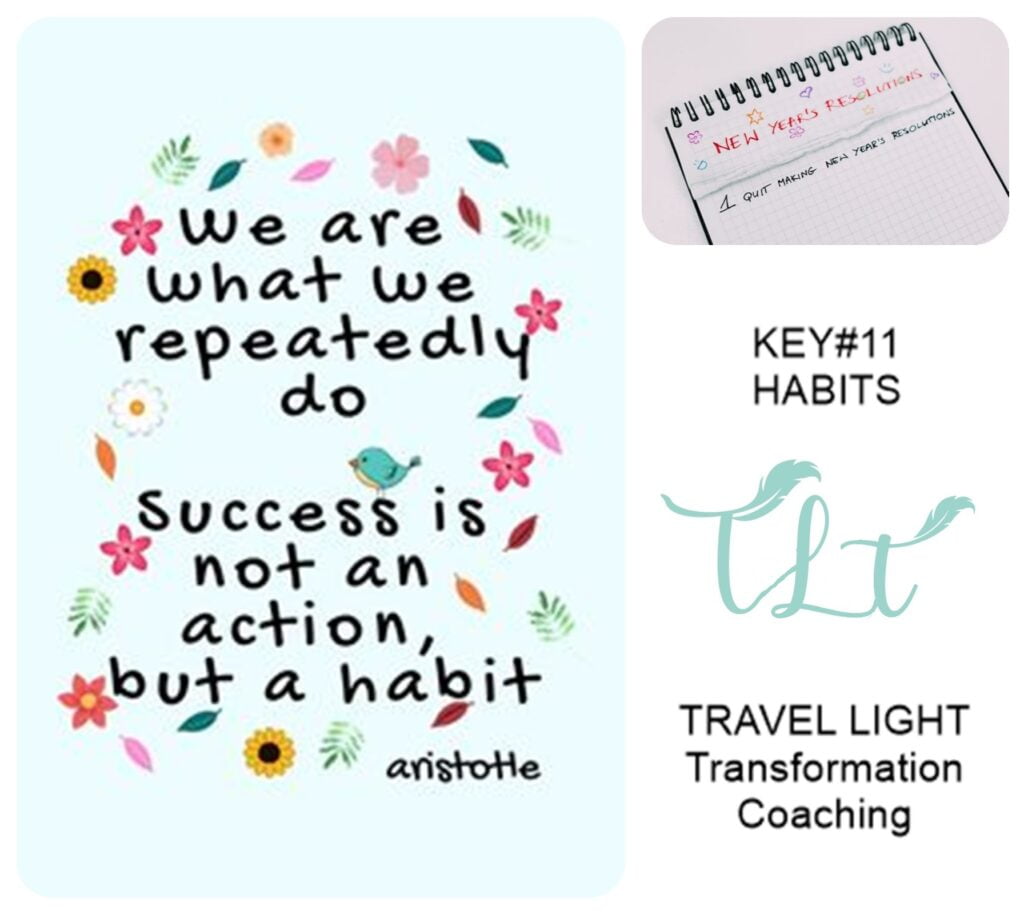
‘New Year, new me’ is a mantra seen all over social media platforms this time of year. New Year resolutions were both made and broken since my last article on personal empowerment or becoming the best version of yourself. People are adamant to change bad habits and replace them with successful habits at the beginning of each year, but unfortunately research has shown that less than half of them will succeed. How are habits formed, and why are old habits so hard to die?
What Are Habits?
Let’s take a quick look at habits.
Habits are automatic behaviours that are rooted deeply in your subconscious mind. Your mind is a phenomenal energy operating in your brain that I like to compare with a computer.
The conscious mind is the small portion presented on the screen that you can see, and the subconscious mind is all the thousands of programs running in the background that you are not aware of.
Your subconscious mind is like a gigantic hard drive processing and recording all the information you gather through your five senses. It is constantly looking for shortcuts to get a desired outcome or reward.
Forming habits are one of these shortcuts your subconscious mind uses to manage the information overload that it needs to deal with on a daily basis. For example: if your subconscious can form a habit of automatically driving the same route to work every day, you will have more mental capacity to dwell on meetings you will be attending that day, or what to cook for dinner, while driving.
How to Change bad habits
When we focus on changing bad habits, we need to realise that every habit, good or bad, consists of a three-part habit loop: the cue, the behaviour and the reward. The cue is the trigger that sparks the habit. Ask yourself what needs to happen, or when, why and / or where does it need to happen? The cue is very important, so spend as much time on introspection as needed to get all the relevant information on the cue. The behaviour is the action of the habit itself, and the reward is the result you get by engaging in the habit, also very important. If you want to change a bad habit, your best chance of success is to break the loop.
During the holidays, I found myself caught up in this farming game on my phone, introduced to me by my kids – Hay Day. The animals are very cute and entertaining, and it also develops certain skills like planning ahead and patience.
My husband was not impressed by the game, as there are no signs of bad harvests, crashed markets or pests, but that’s just a piece of useless information. For me, it soon turned into a bad habit of grabbing my phone first thing in the morning to care for my animals and spending unproductive hours during the day playing a game on my phone. Although it was easy for me to change this bad habit after the holiday by simply deleting the game from my phone, I still want to apply the habit loop to this example for illustration.
My triggers are relaxation bordering on boredom, feeling guilty about this (sigh!) and then the need to be productive, yet still relaxed. That is when I install a game on my phone = the cue. The behaviour is obviously playing the game for hours.
The reward is feeling productive (yes, I am aware it’s only fictional), keeping my mind busy with planning, the satisfaction of seeing the flawless result of good planning and the anticipation of what the next level up will bring. Not too hard to identify the ‘positive’ rewards, because that justifies the habit, right? The negative rewards are often only visible later and not always easy to directly link them to the habit. In my case it was increased irritability and neglecting relationships, chores and some of my good habits, like exercising.
Incomplete list of bad habits – the obvious ones, as well as a few not-so-obvious ones:
- Any substance abuse, including smoking
- Drinking too much coffee
- Giving in to your cravings
- Having desert after every meal
- Overeating that leads to unwanted weight gain
- Constantly blaming others
- Complaining and self-pity
- Emotional eating
- Gossiping
- Taking offence and holding grudges
- Worrying
- Bullying – physically and / or emotionally
- The need to always be ‘busy’
- The need to always be ‘right’
- Checking your phone incessantly for new mails or messages
- Binge watching Netflix series
- Nervous twitches, including nail biting
- Being critical or judgmental
- Procrastination
- Gambling / gaming
5 Tips on how to change bad habits:
Now, you will very seldom hear (or read) me say this, but: when you want to change bad habits, focus only on the negative rewards once you’ve identified them.
Break the loop. Identify the cue and then find another action that would give you similar rewards. In my example, when I’m on holiday again and boredom starts creeping up, I will make sure to have another creative project available that I can work on, like mosaic or painting.
Confide in a friend. Once you voice your triggers and the rewards, especially the negative ones, it gets easier. Ask your friend if he / she can think of more negative rewards and to keep you accountable.
Research has shown that people are more likely to perform habits when they are in the same environment. So: if you want to quit smoking, the perfect opportunity will be when you are going away on holiday. Not only will there be a change in your environment, but also in your routine.
Replace the bad habit with a successful habit. If you want to change the bad habit of worrying, replace it with the habit of being grateful. For example: if the cue to your worrying is any mention of the future, then when your cue is triggered, start giving thanks for today. Be grateful that you are alive, that the sun is shining, or that it’s raining. Grateful that you have food on your table, loved ones, good health, functioning senses, that you are able to read, walk, feel, think: just be grateful for the small stuff. Ask your friend if he / she can think of other behaviours that will give you similar rewards. Sometimes we are too close and too involved to see the most obvious solutions.
Incomplete list of successful habits you can replace bad habits with:
- The Successful Habit of EXCELLENCE – The pursuit to leave people, places or anything you get in contact with, in a better state after you leave. This can start small: from picking up derailed clothes in the store behind you to taking your trolley back to the designated area.
- The Successful Habit of DIGITAL DETOX – Fasting from your phone, social media or laptop for one day per week is liberating, healthy and very much possible.
- The Successful Habit of COLD WATER IMMERSION – The health benefits of this habit is quite impressive. There are lots of information on the web about Iceman Wim Hof’s method, you can research it afterwards if you are interested. Turning the hot water tap off for 30 seconds after your shower will also give you those benefits.
- The Successful Habit of JOURNALLING – writing things down with a pen on paper. Don’t ask me why, but I find there’s some sort of ‘power’ in that. From grocery lists and to-do lists to your thoughts, feelings and even prayers. When I write down my to-do list, suddenly I get more stuff done in a day. When I write my feelings down, suddenly I start feeling better. Even by writing my prayers down, I feel stronger in my faith. And if it’s all in my mind, I will still keep my mind productive by writing everything down anyway. Try it!
- The Successful Habit of HEALTHY LIVING – Check your grocery list. If there are no crisps or candy in your house, you cannot snack on it at 22h00 when you are overcome by cravings. Drink more water. Practice focused eating with a purpose, being mindfully aware of what you put into your mouth and what good or bad it’s going to do to your system.
- The Successful Habit of TAKING RESPONSIBILITY – Not easy at all, but the ability to owe up to your own mistakes, as well as the mistakes of others (ouch!) is a trait that can promote you all the way up to a managerial position in your company. Blame shifting and throwing colleagues under the bus will assure you stay right where you are – at the bottom.
- The Successful Habit of MINDFULNESS – Living in the present moment, the “now”.
- The Successful Habit of OPTIMISM – to always see the silver lining.
- The Successful Habit of regular EXERCISE
- The Successful Habit of PRODUCTIVITY
- The Successful Habit of MEDITATION
- The Successful Habit of unconditional FORGIVENESS
- The Successful Habit of GENEROSITY
- The Successful Habit of GRATITUDE
- For the believer: The Successful Habit of GOD TIME – Spending time with God in prayer and in His Word is both exciting and vitally important for spiritual growth. Especially if you go through a phase where you feel far from God. Yes, I know you constantly talk to Him while driving or while going about your daily routine, but this habit is more about listening than talking. And to listen, you need to be quiet and still. Working on your relationship with God is one of the best investments you can make in your spiritual life. Once your daily quiet time with Him becomes an essential habit, you will feel closer to God and experience His Spirit and blessings in your life.
If you are ready to start living a life in abundance and if you’ve followed the tips in this article for at least 30 days, but still struggle to change bad habits and to replace them with successful habits, don’t despair! The 20-hour virtual online Transformation Coaching System™ that I use, will automatically prepare you subconsciously to identify your habit loops. As soon as you drop your mental and emotional baggage and Travel Lightly through life, you will find the will-power hidden on the inside of you to change or learn any habit.
Contact me TODAY for a free 30 min online Session!
Learn how to create successful habits with me. I am a certified Transformation Life Coach operating in Riebeek Kasteel, Western Cape of South Africa. I also do virtual online life coaching sessions, so no matter where you are situated, all you need is an internet connection, a mobile phone or computer, and a space where you can meet with me uninterruptedly once a week for two hours.
Follow me on Instagram or like my Facebook page.
The next key #12 to personal empowerment (becoming the best version of yourself) is the POWER OF FORGIVENESS.
SUCCESSFUL HABITS REFERENCES:
Stephen R. Covey; The 7 habits of highly effective people; 1989; Simon & Schuster; USA
https://www.psychologytoday.com/za/blog/striving-thriving/202110/the-neuroscience-habits
https://www.npr.org/2012/03/05/147192599/habits-how-they-form-and-how-to-break-them
https://www.google.com/search?q=science+and+habits&oq=science+and+habits&aqs=chrome..69i57j0i22i30l2j0i390l4.3192j0j15&sourceid=chrome&ie=UTF-8#fpstate=ive&vld=cid:95bb6c99,vid:Wcs2PFz5q6g
https://www.youtube.com/watch?v=Wcs2PFz5q6g
