


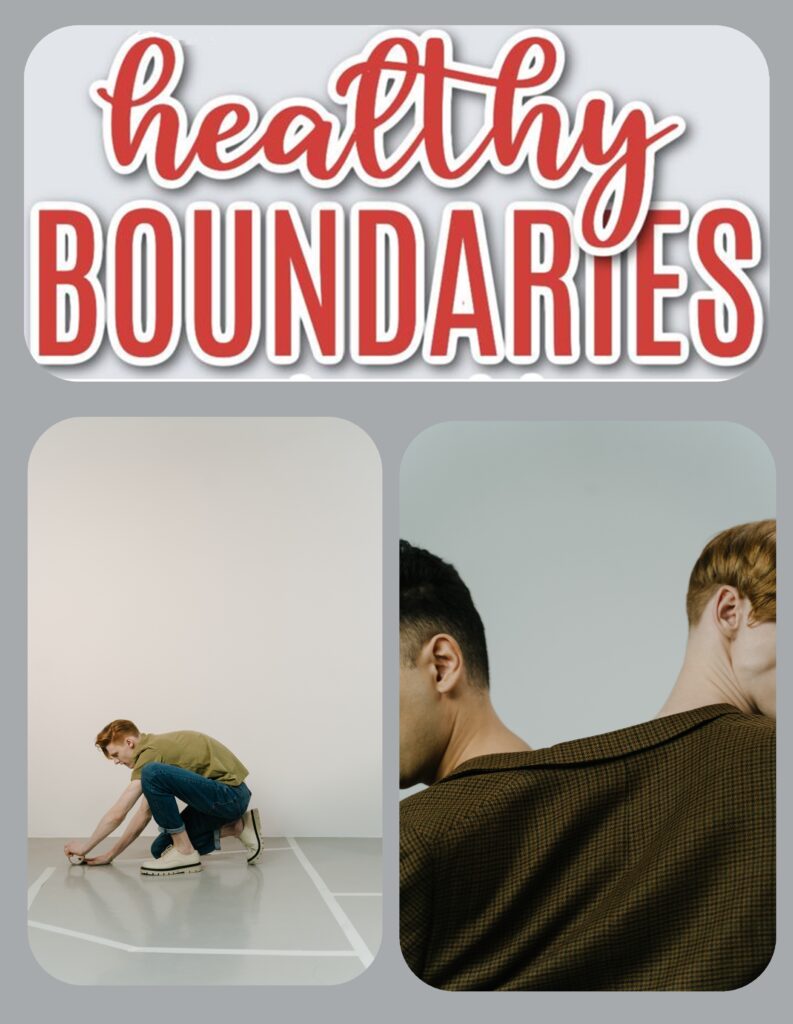
As we all know, boundaries are property lines, defining ownership. Let’s start this key by taking your plot as a practical example. The property lines around your plot clearly states where your property begins, and where it ends. And where the neighbor’s property begins and ends. You each own a title deed to your respective properties, giving you control, responsibility and freedom to do as you please on your own property, right? Right. Now, the same goes for personal boundaries in relationships. Healthy boundaries should clearly state where you end, and another person begins.
Each person needs to take control and responsibility for their own life within those boundaries. Like the boundary around your plot, personal boundaries keep the good stuff in, and the bad stuff out. These boundaries are permeable; it’s important to note that it’s not a 10 ft brick wall. People can come into your life and leave again, but here’s the thing: if somebody trustworthy comes along, you have control to let that person in. And you have control to keep the burglars out. It’s your choice who you let in, and who you keep out.
The same goes for responsibility. You are not responsible for the tree on your neighbor’s plot. He needs to trim it so that the branches don’t reach over and drop leaves onto your property. And vice versa of course. Each person needs to take responsibility for the following 7 aspects in their own life: emotions, values, thoughts, passions, weaknesses, strengths and history. For the believer: I believe the word heart in the assignment to ‘guard your heart with all vigilance for out of it flow the springs of life’ (Prov 4:23) includes all 7 of these aspects.
Discovering Your Personal Boundaries
Your personal boundaries also need to define who you are, and who you’re not. What you like, and what not. I just have to randomly add here that these boundaries can often overlap with another’s, as in the case of a long term, healthy marriage. This is a permissible exception, as long as there is mutual respect in that relationship. Both partners must keep in mind though, that you can never change anybody else. The only person you have control over to change, is YOU.
Signs that you lack personal boundaries:
- You agree when you know you should have disagreed, and then you feel resentment towards yourself or others afterwards.
- You often indulge in emotional eating to dull these feelings of resentment.
- You have toxic relationships.
- You fail to speak up when mistreated.
- You often feel like a victim.
- You don’t feel appreciated and validated by others.
- You often overcommit and then feel like you’re disappointing people when you can’t produce.
- You feel it’s your job to “fix” or “save” others.
- You have an overdeveloped sense of responsibility for the feelings and behaviours of others.
- You resent others for having needs.
- You feel guilty, afraid, or selfish when you consider setting boundaries.
- You often feel angry or irritated with others, but you will never tell them.
Healthy Boundaries have three great functions:
- Healthy boundaries prevent burnout, by increasing your mindfulness.
- Healthy boundaries teach others how to treat you.
- People learn to trust you more as your “yes” means “yes” and your “no” firmly means “no”.
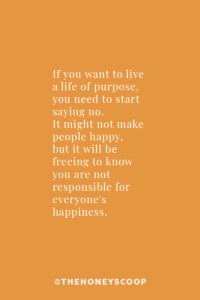
Healthy Boundary – How to say “no”:
There are countless examples of healthy boundaries that you can set in relationships, in your work environment and in your personal life. The one I want to focus on in this article is the one I struggle with most: How to say “no” without feeling guilty. When we always say “yes” we are deceiving ourselves on a deeper, underlying subconscious level. When you’ve mastered this skill, it’s much easier to set other boundaries later that you feel the need for. I hope this article will help you establish some boundaries in your life, without feelings of overwhelming guilt.
5-point Checklist for Setting Healthy Boundaries
To help you get started, I want to give you a 5-point checklist that helps me a lot. If your help is asked, and it’s in your nature to just blindly agree because of the way you were conditioned, seriously consider five things first:
- Can the person provide whatever they’re asking of me, for themselves? Are they unable to, or unwilling to?
- Do I have all the resources to help? This includes time, energy and / or money.
- Who will be compromised by my decision? Will it only affect me, or my loved ones as well?
- Do introspection. Why do I want to say “no”? Once I’m sure it’s not only to be difficult, I can continue to ask myself: How does this decision make me feel? Cheerful or heavy? Guilty and obliged? Closely and honestly check your heart. When you have peace why you say “no”, it doesn’t matter who you say “no” to.
- What is the fruit of my giving? It can either be gratitude or ingratitude. What has this person done for me lately? Or am I unknowingly encouraging unhealthy dependency in the relationship?
Saying “no” is a healthy boundary. Saying it in a way that is firm yet kind, and without feeling guilt-ridden afterwards, is a must-have skill and a successful habit to learn. We were all born with the ability to easily say “no”. Maybe not very tactful or considerate, but the word came very naturally and easy. Any parent of a toddler will know exactly what I’m talking about. But as we grew older, some of us were conditioned into doing as we were told, so we lost that inborn ability.
Boundaries and Guilt
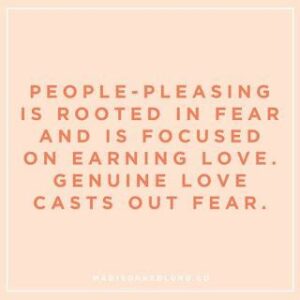
But why do I feel so guilty after I’ve set my boundary by saying “no”? Is that not a sign that I should have said “yes” and helped out? Let’s look at the emotion ‘guilt’: Guilt is the feeling that you have when you have done something wrong. Guilt is therefore not always a negative emotion. When you feel guilty after deliberately hurting somebody, that feeling is appropriate, and you need to make amends. However, after applying the 5-point checklist above, and you say “no” to protect your boundary, you become aware of the fact that you have caused some discomfort for the other person. He / she must now either find somebody else to ask, or do it themselves. This awareness triggers an endless addiction that I like to call our Inner People-Pleaser Default Setting – the need for validation from others to feel good about ourselves. And that is where the guilt originates from. This type of guilt is not our friend. In fact, psychologists claim that the 2 main ingredients for showing symptoms of depression and anxiety are feelings of guilt and shame. By learning to say “no” without guilt, is not only a skill, but also a natural remedy for depression and anxiety.
For the believer:
Jesus asks His followers in John 5:44: “How can you believe when you receive glory and approval from one another, and yet you do not seek the glory and approval which comes from the one and only God?” If you’re a believer who is in a relationship with God, you will want to be a God-pleaser and not a people-pleaser. Being a people-pleaser will end up causing you to feel far from God, whereas using your God-pleaser spiritual muscle, will make you feel closer to God.
6 Steps on how to say “no” guilt-free:
Step 1: Create some space by telling the other person that you will think about it and come back to them in a specific time frame. Grant yourself time to go over the 5-point checklist. Also: Give the other person space to adapt and react to your “no” if they are upset. Don’t take it personal.
Step 2: Make a helpful counter offer. For example: Your neighbor wants to borrow your lawnmower, but through experience you’ve learned that you don’t receive it back in time or in the same condition. You can kindly suggest they hire one, or you’ve seen a second-hand one they can buy from Amazon. You get the idea.
Step 3: Say it simple and to the point. A lengthy explanation can open the refusal up for negotiations. You don’t have to justify your position.
Step 4: Afterwards, stand by your answer. Let your “yes” be “yes”, and your “no” be “no”.
Step 5: Apply the Type A / B theory. Let me explain in short: A Type A problem is your problem. It affects you directly, and you can take 100% responsibility. On the other hand, a Type B problem is someone else’s problem. It is not your responsibility. You have to work hard not to make it your problem.
Step 6: Do introspection of your feelings. Identify and acknowledge the emotion, and try to make sense out of it. If you still feel guilty, ask yourself: Why do I feel guilty saying “no” to this person? Is the relationship healthy?
Tips on setting additional healthy boundaries:
- Be honest with yourself and others.
- Use the word “no” every day to normalise it. Every time you say “no”, neural pathways get stronger, and you change bad habits of overcommitting yourself.
- If you say “no” to maintain values or priorities, tell the other person.
- Spend time to clearly identify your boundary in various relationships for yourself first. For example: I will not invite any client on my social media, versus: Facebook is taboo, but I will allow them on Instagram. Or: I will not give my personal cell phone number to any of my new colleagues, versus: only to my superior.
- Start with tighter, more rigid boundaries. It’s always easier to ease up on boundaries, than to tighten them once they’ve been set. For example: I will never leave the office after 17h00. Then, when it does happen occasionally that you need to work overtime, it is clearly an exception to the rule and not the norm.
- Don’t apologize or give lengthy explanations.
- Keep the tone of you voice calm and polite.
- Communication is key here. Don’t expect others to just figure out your boundaries for themselves. And notify the trespasser as soon as they cross your boundary. It only gets more difficult and awkward the more times they violate your boundary.
- Use “I” statements, instead of “you” statements. For example: “I need more time for myself”, and not: “You need to stop coming over to my house all the time”.
- Respect the boundaries others have set for themselves.
The Power of Healthy Boundaries for the believer: Selfishness vs Stewardship
Do you realise that God also has boundaries? Scripture clearly states who He is, and who He isn’t. What He likes, and what He doesn’t like. God is Love (1 John 4:16), Truth (Jer 10:10) and Light, and there is no darkness in Him at all (1 John 1:5). He likes us to lead a quiet and peaceable life in all godliness and honesty, and for all men to be saved (1 Tim 2:3-4). Lying lips are abomination to the LORD: But they that deal truly are His delight (Prov 12:22). Clear boundaries!
Boundaries for a Christian have an additional great function: We are protecting the gift of stewardship. “Sometimes we need to say ‘no’ to some good things so that we can do the best thing God has called us for” – Dr Henry Cloud.
This is a concept many of us (including me) are not used to. We need to remember that every need is not necessarily a calling. There are a gazillion needs out there; it’s impossible for anybody to meet all of them. Setting healthy boundaries will actually help you to be able to assist others better. But what about my own needs?
Take note: Not wishes or desires, needs. Some people see their own needs as bad, selfish or an undeserved luxury. Others see their needs as something that God or others should do for them. But the assignment is clear: Guard your (own) heart – your life (and needs) is your responsibility.
Selfishness is an unhealthy fixation on one’s own wishes and desires. Stewardship is managing everything we have – our gifts, talents, finances, relationships, health and the 7 aspects listed above – to the best of our ability, but more importantly: To the glory of God.
Personal Boundaries Aren’t Selfish
If you have never set personal boundaries because you believed it to be selfish or self-centred, I believe that boundaries are from God to give you your life back, and to start living a life in abundance.
In the parable of the talents in Matthew 25, the master said to the two servants who took good care of what was entrusted to them: “Well done, good and faithful servants. You have been faithful and trustworthy over a little, I will put you in charge of many things; share in the joy of your master (v21).
And later, Jesus said in verse 29: “For to everyone who has [and values his blessings and gifts from God, and has used them wisely], more will be given, and he will have an abundance.” Your life is a gift from God. Your mental health and spiritual and emotional growth are God’s interest on His investment in you. When you set healthy boundaries, you are protecting God’s investment. Can you see the difference between selfishness and stewardship?
Learn More About Setting Health Boundaries
I am a certified Transformation Life Coach operating in Riebeek Kasteel, Western Cape of South Africa. I also do virtual online life coaching sessions, so no matter where you are situated, all you need is an internet connection, a mobile phone or computer, and a space where you can meet with me uninterruptedly once a week for two hours.
Contact me TODAY for a free 30 min online Session!
Follow me on Instagram or like my Facebook page.
The next key #7 to personal empowerment (becoming the best version of yourself) is the POWER OF EMOTIONAL INTELLIGENCE.
REFERENCES:
- https://www.rsg.co.za/rsg/potgooi-resultaat/?_sft_category=wie-is-ek-potgooi&post_date=20220513,
- https://www.youtube.com/watch?v=Mzldv3TvdiY,
- https://www.facebook.com/UofAfirstpeopleshouse/photos/setting-boundaries-is-the-key-to-a-healthy-relationship-personal-boundaries-are-/3091131797663429/,
- https://m.facebook.com/thevienaturelle/photos/a.125746652322505/367406848156483/,
- https://therapydave.com/self-help/the-consequences-of-not-having-any-boundaries/,
- https://themindsjournal.com/tag/healthy-boundaries/,
- https://psychcentral.com/blog/imperfect/2016/05/10-steps-to-setting-healthy-boundaries#Join-the-conversationon-my-Facebook-pageas-we-inspire,-educate,-and-help-each-other-heal!,
- https://positivepsychology.com/great-self-care-setting-healthy-boundaries/,
- https://www.boundariesbooks.com/blogs/boundaries-blog/am-i-being-selfish-when-i-set-boundaries
