


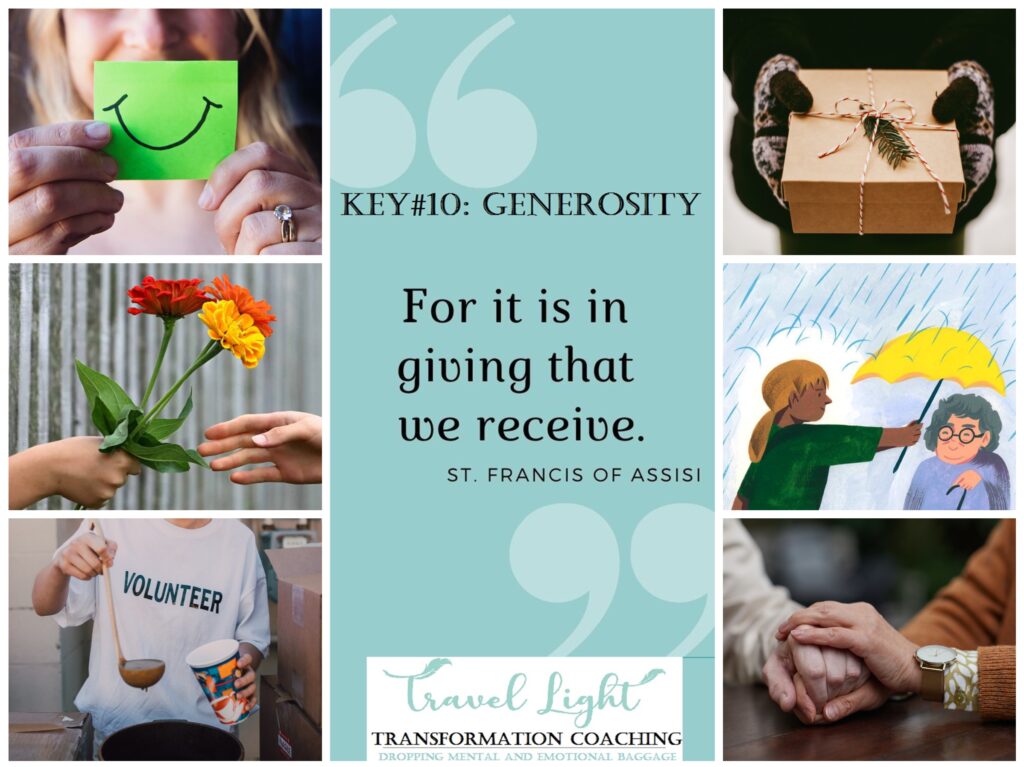
Welcome to the halfway mark in my series of non-academic articles on personal empowerment – becoming the best version of yourself and living a life in abundance! Thank you for reading and sharing my articles as far and wide as possible. The Power of Generosity is another important key as it is beneficial for both the receiver and the giver. In this article, I will explain the why, what, and how of giving, as well as share some practical tips on how to get you started.
What is The Power of Generosity?
To be a generous person means you are sacrificial and unselfish in your giving. Your left hand does not know what your right hand is giving (Mat 6:3). You give without any expectations. You give simply because of the joy of giving. This kind of generosity is a learned character trait, meaning it can be taught as a successful habit!
So please parents, teach your children from a young age to give. The benefits for them in later life (the why) will blow your mind! Being generous needs to be an intentional decision that we all make daily, as unfortunately being selfish is our default setting.
I realise that with current economic recessions in many countries, you might believe that this kind of giving is impossible, unpractical, or wishful thinking, but I can assure you it is well within everybody’s reach (the how). Most of us will not be able to donate millions of dollars to a charity but believe me: we can still be generous. Let’s dive deeper into the power of generosity.
Why is generosity important in life? (The why)
Let’s briefly take a look at what happens in the brain when we give. Neuroscientists have discovered that three crucial neurotransmitters that form part of the body’s reward system are released when we give a gift or help somebody: oxytocin, serotonin and dopamine, also known as the Happiness Trifecta.
I will summarize the benefits of each of these natural chemicals:
Oxytocin, the cuddle hormone, is linked to warm, fuzzy feelings towards others, increasing our empathy, as well as our trust. It also boosts our mood, and counteracts the harmful effects of cortisol, the dangerous stress hormone. Some research even shows that it lowers symptoms of stress and anxiety. Physically, oxytocin lowers blood pressure and reduces pain because of its anti-inflammatory properties.
Serotonin influences learning, memory and happiness. It regulates body temperature, digestion, sleep, sexual behaviour and hunger. It is also thought to counteract symptoms of depression and anxiety.
Dopamine, the “feel-good” hormone, gives us a sense of pleasure, satisfaction and motivation.
Small, repeated boosts of the Happiness Trifecta is most beneficial, so an annual, large financial donation is not ideal. You owe it to yourself to give, and to give often! Giving is one of the natural remedies for depression and anxiety! But why are we sometimes so reluctant to give?
There are 4 main culprits that prevent us from giving freely and generously:
- Fear
- Greed
- Egotism
- Apathy
FEAR: An age-old enemy that’s never too far away, waiting for the perfect time to strike. Fear regarding giving can take several forms: You might have the fear of running out of resources yourself, now or in the future. The fear of cultivating an unhealthy independence or instigating a culture of entitlement towards receiving can also prevent you from giving. “Maybe my offering is not good enough” or “What if I offend the person in some way?” are also fears.
GREED: The love of money and power can become like a drug. The more you have, the bigger your desire becomes to obtain even more. The addiction causes you to never have enough, and the idea to part with any of it to help somebody else, doesn’t even cross your mind. “Whoever loves money never has enough; whoever loves wealth is never satisfied with their income. This too is meaningless” (Ecclesiastes 5:10). We need to change bad habits by replacing greed with generosity.
EGOTISM: Sometimes we tend to focus so intently on ourselves and our own circumstances, that we really don’t notice the needs of others around us. Almost like wearing blinkers. By increasing our mindfulness – living in the now and focusing on our surroundings – we become more aware of the needs of others and how we can assist them.
APATHY: To be regularly exposed to serious crime and poverty systematically leads to a lack of empathy. It blunts our emotions, so that we stop feeling for the needy ones. We take the view that it could never happen to us. Somehow, we justify not giving or helping, because we subconsciously start assuming that all the needy somehow brought poverty upon themselves.
Tips on how to increase your giving (the how):
- Firstly, change your perspective of giving if necessary (the what). Many are reluctant to give, because they barely make ends meet themselves. But hey, remember: money is only one aspect that can be gifted. There are also time, compassion, encouragement, kindness, attention, aid, advice, compliments, jokes and much more that you can be generous with, free of charge. Be creative! Become a blood donor and help save lives. Or volunteer in your community’s soup kitchen over weekends.
- Consider the positive benefits for you, the giver. Although that shouldn’t be the main reason you give, it sure helps to get you started. Generous people seem to be happier, healthier, more satisfied and more purposeful. And neuroscientists have explained why.
- Start small. Look out for the little opportunities that arise daily. Give small, but give often. Keep fruit in your car that you can hand out to beggars at traffic lights.
- Give first. Make a decision to give at the beginning of the month, and not what’s left over at the end of the month. There will never be left over to give. But when you give first, somehow what’s left will still be enough for you to come out with.
- Fund a charity based on your passions. Animal lover? SPCA. Sport fanatic? Local club. Nature and conservation? WWF. Religion? Local ministry. You get the picture.
- Reallocate one specific expense to the chosen charity. For example: smoke two cigarettes less per day, cook at home more often instead of going to a restaurant, walk or cycle to work once per week, buy one less soda, cappuccino or sweet, use single-ply toilet paper or reuse teabags. Find an expense relevant to your lifestyle. Work out how much money you will save in a month, and donate that amount to the charity based on your passion, whether it’s $5 or $500.
- Create a beautiful cycle of smiling. When you give and your Happiness Trifecta is released by your brain, don’t hide your smile! The world will smile with you, as you are triggering their mirror neurons.
- Strike up a random conversation (keep your tone light and friendly) with a stranger. Ask the lady at the supermarket pay point what time her shift ends. Or thank the cleaner at work for the spotless bathroom floor. Or encourage an exhausted parent with toddlers. I realise it’s not so easy for an introvert. You can start by making eye contact, smile and say: “hi”. It will get easier, and you will be able to start short conversations soon!
- Lastly: Adopt an attitude of gratitude. When you realise how much you have to be thankful for, you will be more willing to part and share some of it.
The Power of Generosity for the believer:
We serve a generous God. What better example of sacrificial generosity can possibly exist than what we read about in the famous verse John 3:16? And as we were created in the image of God, I’m convinced that God designed our bodies to be able to be naturally generous and compassionate with the help of His Spirit. Paul instructs us to give what we have decided in our hearts to give, not reluctantly or under compulsion, for God loves a cheerful giver (2 Cor 9:6). Yes, because He knows that a giver can only be cheerful and happy, as neuroscientific research has shown us! Isn’t Scripture just so relevant, awesome and vibrantly alive? I get so excited every time I realise what benefits God’s loving guidelines, written in His Word thousands of years ago, have for us, His children today.
Jesus is also the perfect example of generosity. Whoever He encountered, He always left them with more than they expected to receive. Even though He and His disciples struggled financially, He still gave freely of His time, compassion, healing and power.
When you feel far from God in your relationship with God, it’s time to start increasing your giving. Don’t get me wrong: not to “buy” or “deserve” your salvation in any way, but to be obedient to a God who loves you, and to feel closer to God.
Contact me TODAY for a free 30 min online Session!
Ready to embrace the power of generosity? I am a certified Transformation Life Coach operating in Riebeek Kasteel, Western Cape of South Africa. I also do virtual online life coaching sessions, so no matter where you are situated, all you need is an internet connection, a mobile phone or computer, and a space where you can meet with me uninterruptedly once a week for two hours.
Follow me on Instagram or like my Facebook page.
The next key #11 to personal empowerment (becoming the best version of yourself) is the POWER OF HABITS.
REFERENCES:
https://www.psychologytoday.com/za/blog/vitality/201404/the-neuroscience-giving
https://www.fool.com/the-ascent/banks/articles/7-ways-be-generous-without-spending-more/
